ToupTek ATLAS SH20 Strain Wave Equatorial Mount
Coming soon
Tell me when it’s in
Leave your email and we’ll let you know as soon as it’s in stock, with the price.
- Delivery
- £5 tracked UK delivery, free on orders over £250. Outside the UK, the cost is shown in your basket. Delivery
- Warranty
- Manufacturer warranty, handled by us in the UK.
- Returns
- 14 days to return unused items. Returns policy
Overview
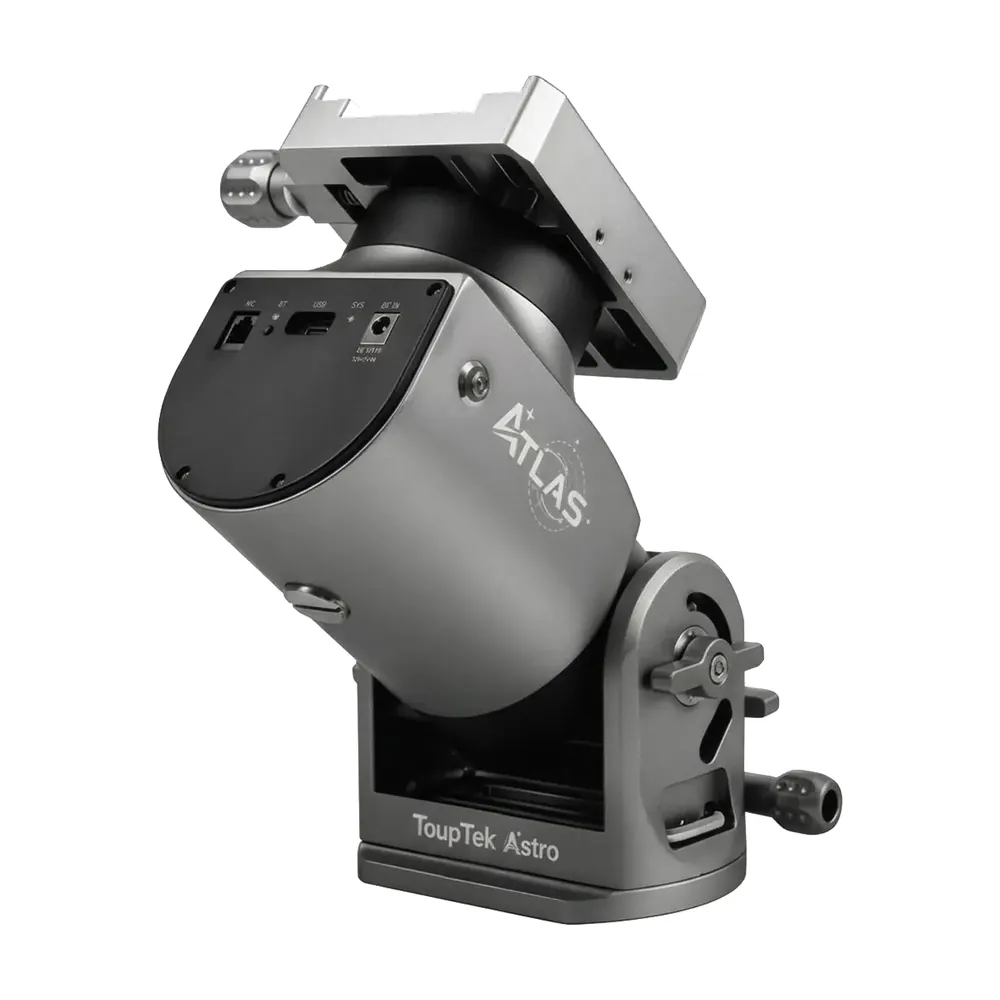
The ToupTek ATLAS SH20 is a strain wave equatorial mount, also called a harmonic drive mount, for astrophotography and visual observing. The head weighs 5.1 kg and carries 20 kg without counterweights, or up to 30 kg with them.
It switches between equatorial and alt-az mode without restarting, and works with ASCOM, INDI and INDIGO software as well as ToupTek’s own apps.
Drive and tracking
Each axis has a brushless servo motor driving a 100:1 strain wave gear directly, with no belts in between. With no belts there’s nothing to tension or wear, and very little backlash.
The mount tracks at sidereal, solar and lunar rates. Periodic error, the small repeating drift in tracking that comes from the gear, is 30″ peak to peak or less. Every mount comes with a test report of its own periodic error.
For long deep-sky exposures, use autoguiding. Guiding software watches a star and sends small corrections to the mount through its ASCOM or INDI driver, so no separate guide cable is needed.
There are ten speeds for moving the mount, from 0.25× to 1440× tracking speed. The fastest equates to a slew speed of 6° a second.
Payload and balance
Both payload figures assume the load’s centre of gravity is 20 cm from the mount. Up to 20 kg needs no counterweights. From 20 kg to 30 kg, fit counterweights on the M12 shaft as set out in ToupTek’s manual. Counterweights are sold separately.
A large telescope puts its centre of gravity further out, which lowers what the mount can carry. Even under 20 kg, a counterweight takes load off the motors. Three payload modes, Light, Standard and Heavy, match the motor output to the load. ToupTek recommends Heavy mode in cold weather.
Equatorial or alt-az
In equatorial mode the SH20 tracks on one axis, so long exposures don’t suffer from field rotation. Alt-az mode needs no polar alignment, so it suits visual observing, quick tours of the sky, EAA and solar system imaging.
For polar alignment, the latitude adjustment covers 0° to 90° on two scales, 0–60° and 30–90°. The azimuth knobs turn the head up to 6° left or right, so you can fine-tune its aim without moving the tripod.
Control and software
ToupTek’s apps run the mount from a computer, an Android phone or tablet, or an iPhone or iPad. It connects by Bluetooth 5, 2.4 GHz Wi-Fi or a USB-C cable. The hand controller has an eight-way joystick, a lock switch, programmable buttons and its own Wi-Fi hotspot, on a coiled cable.
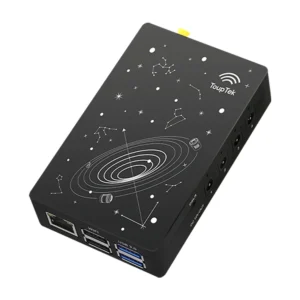
Drivers cover ASCOM, INDI and INDIGO, so it works with N.I.N.A., SharpCap, KStars and MaxIm DL. It also works with the ToupTek StellaVita controller, for imaging without a laptop. Through the software you can GoTo and sync, park, find home and set meridian flip limits.
Power
The mount runs from 12 V DC, and ToupTek recommends a regulated 12 V 5 A supply. A 12 V 5 A output on the mount powers accessories. The USB-C port carries data only, not power.
Built-in protection
- A mechanical brake locks the RA axis if the power fails.
- Home sensors on both axes let the mount find its home position again after a fault.
- Altitude and meridian limits are set in software.
- If either axis hits something, the mount backs off slightly and locks that axis.
- Overcurrent and overvoltage protection.
- Once parked, it ignores movement commands until unparked.
- Command beeps, with three volume levels.
Build
The body is CNC-machined aluminium with a matt anodised finish in silver-grey. The knurled knobs are large enough to turn in gloves. The saddle takes both Vixen and Losmandy dovetails, and the supplied hex keys sit on a magnetic holder on the mount. It works from −20 °C to +40 °C.
Specifications
| Type | Strain wave (harmonic drive) equatorial mount |
|---|---|
| Modes | Equatorial and alt-az, switchable without a restart |
| Drive | Brushless servo motors, 100:1 strain wave gears |
| Periodic error | 30″ peak to peak or less, test report with each mount |
| Encoders | 18-bit |
| Tracking rates | Sidereal, solar, lunar |
| Guiding | Pulse guiding through ASCOM or INDI (no ST-4 port) |
| Slew speeds | 10, from 0.25× to 1440× sidereal |
| Fastest slew | 6° a second |
| Payload without counterweights | 20 kg |
| Payload with counterweights | 30 kg |
| Payload rated at | Centre of gravity 20 cm from the mount |
| Counterweights | Optional, on an M12 × 1.75 shaft (sold separately) |
| Saddle | Vixen and Losmandy |
| Power-off brake | RA axis |
| Connections | USB-C (data), 2.4 GHz Wi-Fi, Bluetooth 5, hand controller port |
| Software | ToupTek apps (computer, Android, iOS), ASCOM, INDI, INDIGO, StellaVita |
| Power in | 12 V DC, regulated 12 V 5 A supply recommended |
| Power out | 12 V, 5 A |
| Latitude range | 0–90° (scales 0–60° and 30–90°) |
| Azimuth adjustment | ±6° |
| Operating temperature | −20 °C to +40 °C |
| Mount head weight | 5.1 kg |
Specifications from the manufacturer. Check with us if a figure matters for your setup.
Questions
Do I need to autoguide with the ATLAS SH20?
For long deep-sky exposures, yes, as with most imaging mounts. Strain wave mounts are designed to be guided, and short guide exposures of a second or less keep stars round. For visual observing, EAA and short exposures at short focal lengths, it tracks well on its own.
Is 30″ of periodic error a problem?
No. Periodic error is the small, repeating drift in tracking that every geared mount has, and 30″ is typical for a strain wave mount. Guiding corrects it during the exposure. Every SH20 comes with a test report of its own periodic error, so you know exactly what you’re getting.
Do I need counterweights?
Not up to 20 kg. From 20 kg to 30 kg, fit counterweights on the M12 × 1.75 shaft. They’re sold separately. A counterweight is still worth having below 20 kg with a long or heavy telescope: it takes load off the motors and makes the whole setup less likely to tip.
Will it carry an 8-inch or 11-inch Schmidt-Cassegrain?
By weight, yes. Celestron lists the C8 tube at 5.67 kg, the C9.25 at 9.07 kg and the C11 at 12.4 kg, so each one fits within the 20 kg rating with a camera and guide scope added. The rating assumes the load’s centre of gravity is 20 cm from the mount, though. A bigger tube puts it further out, which lowers what the mount can carry. With a C11, fit a counterweight and leave some margin.
What happens if the power fails?
A mechanical brake locks the right ascension axis, so the telescope can’t swing round under its own weight. When the power comes back, home sensors on both axes let the mount find its home position again.
Can I use it for visual observing?
Yes. Switch to alt-az mode, which needs no polar alignment, and point it with the hand controller, ToupTek’s app or your planetarium software. It changes between alt-az and equatorial mode without a restart.
Will it work through a British winter?
ToupTek rates it from −20 °C to +40 °C, which covers UK nights. In cold weather ToupTek recommends the Heavy payload mode, which gives the motors more output.
Can I run it from a battery?
Yes, from any 12 V DC source that can supply 5 A. ToupTek recommends a regulated supply, so choose a power tank with a regulated 12 V output. We don’t have a figure for its power use yet, so we can’t say how long a given battery will last.
Does it have an ST-4 guide port?
No. Guiding goes through the ASCOM or INDI driver instead, which is called pulse guiding. PHD2 or N.I.N.A. sends its corrections over the same connection that controls the mount, so there’s no guide cable to add.
Will it work at UK latitudes?
Yes. The UK lies between about 50° and 59° north, which sits on the mount’s 30–90° latitude scale.
Is a strain wave mount the same as a harmonic drive mount?
Yes. Strain wave gearing and harmonic drive are two names for the same kind of gearbox. It gives a high reduction, here 100:1, in a small, light body with very little backlash.
What tripod does it fit?
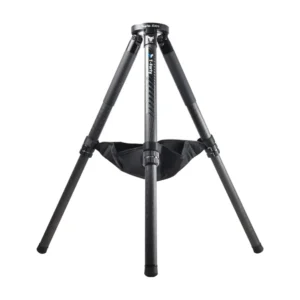
ToupTek offers it with its T-Forty carbon fibre tripod. We’re confirming the base fitting for other tripods and piers with ToupTek, so ask us before you buy if you plan to use your own.
When will it be in stock in the UK?
We don’t have a date yet. Leave your email in the "Tell me when it’s in" box and we’ll let you know as soon as it arrives, with the price.